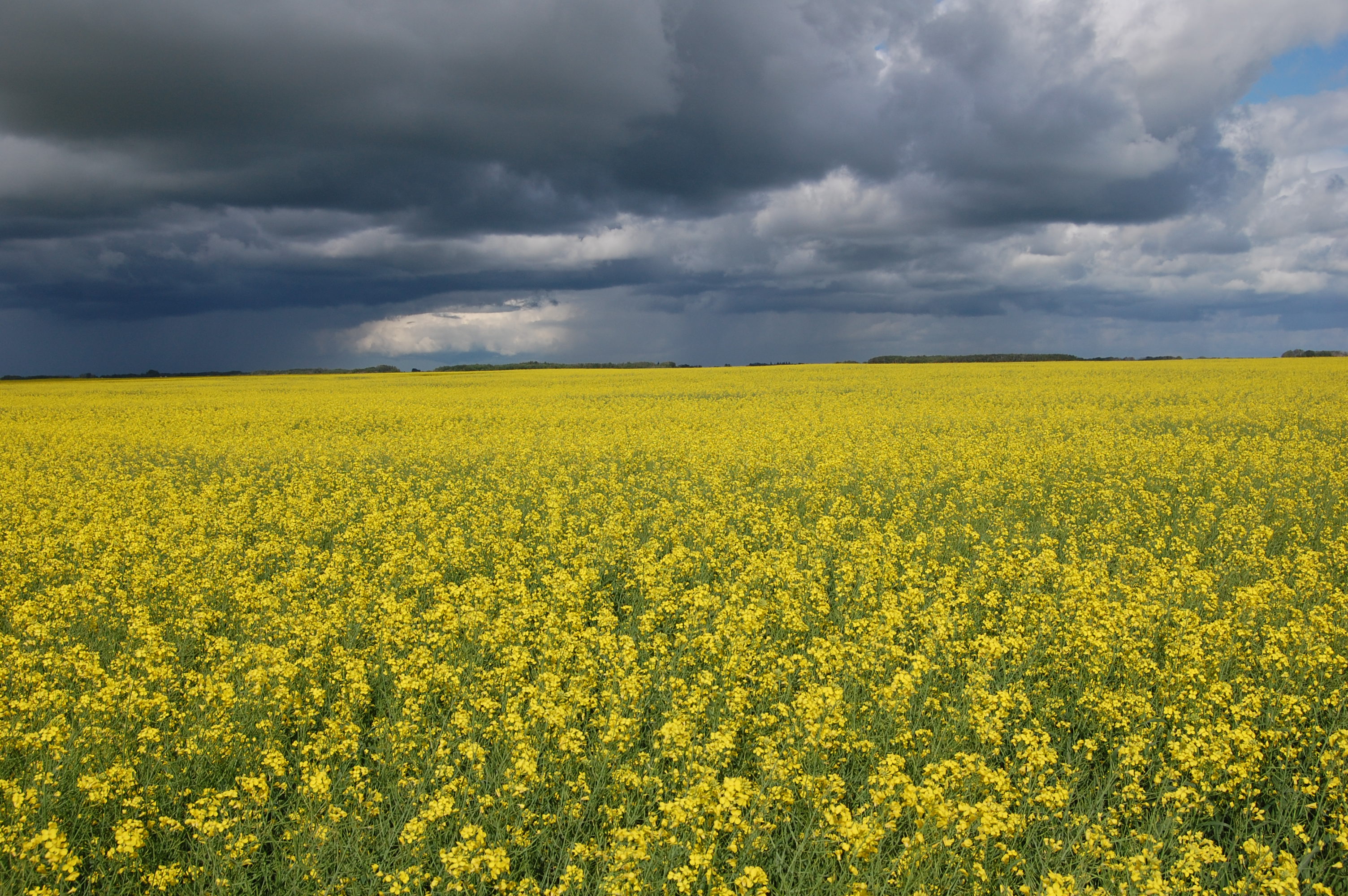
Canola is among the most economically significant field crops in Canada. The name itself originated in Canada — a contraction of "Canadian oil, low acid" — and the crop was developed from earlier rapeseed varieties through conventional plant breeding at the University of Manitoba and other Canadian institutions during the 1960s and 1970s. The primary objective was to reduce the erucic acid content of the oil and the glucosinolate content of the meal to levels acceptable for human and animal consumption. The result was a new crop category with broad food, feed, and industrial applications.
Canada consistently ranks as one of the world's largest producers and exporters of canola seed and oil. Saskatchewan, Alberta, and Manitoba each contribute significantly to annual production, with the crop occupying a large share of total seeded area across the western provinces.
Crop Rotation and its Importance
Canola is typically grown in rotations with cereals — spring wheat, barley, or oats — and occasionally with pulses such as field peas or lentils. A minimum of one year of non-canola crop between canola crops is widely recommended; more conservative rotations suggest one year in four or five. Short rotations intensify disease pressure, particularly from soilborne pathogens such as Sclerotinia sclerotiorum and Plasmodiophora brassicae (the cause of clubroot), which can accumulate in fields with frequent canola production.
Rotating herbicide modes of action through crop rotation also plays a role in managing herbicide resistance in weed populations — a problem that has grown considerably across the Prairies with repeated use of the same active ingredients.
Seeding Establishment and Timing
Canola seed is small, averaging roughly 3 to 4 grams per 1,000 seeds. This creates specific seeding challenges: seed must be placed into adequate moisture at a shallow depth, and the seedbed environment must support rapid emergence to avoid excessive pre-emergence mortality from soil crusting, cool conditions, or insect feeding.
Target seeding depth is 1.5 to 2.5 cm. Shallower placement risks poor moisture contact; deeper placement can delay or prevent emergence, reducing plant stand below viable thresholds. Seeding rate is calibrated to achieve a target plant density of 5 to 8 established plants per square metre for hybrid varieties. Below this range, crop competitiveness against weeds declines, and yield losses are possible despite some compensatory branching at lower densities.
The seeding window in western Canada runs from late April through mid-May. Research consistently shows that early seeding — when soil and moisture conditions permit — is associated with higher yield potential. Early-seeded canola uses cool, long spring days for vegetative establishment, then proceeds through flowering and pod fill under conditions more likely to avoid late-summer heat and moisture stress.
Flea beetle feeding is a significant early-season risk in canola. The small striped flea beetle (Phyllotreta striolata) and crucifer flea beetle (Phyllotreta cruciferae) can rapidly defoliate seedlings in warm, dry spring weather. Seed treatments containing neonicotinoid insecticides provide early-season suppression of flea beetle feeding, though their use is subject to evolving regulatory guidance.
Hybrid Varieties and Herbicide Trait Systems
Virtually all commercial canola grown in western Canada today is hybrid, produced through cytoplasmic male sterility (CMS) and restorer gene systems. Hybrid varieties consistently outyield open-pollinated types and offer improved uniformity of maturity, which is important for harvest timing.
The three primary herbicide-tolerant trait systems in Canadian canola production are Roundup Ready (tolerance to glyphosate), Liberty Link (tolerance to glufosinate ammonium), and Clearfield (tolerance to imidazolinone herbicides). Each system requires the use of the corresponding herbicide for weed control, and producers must select a system that aligns with their weed management goals and field history.
Pod shatter resistance — the tendency of pods to remain intact rather than splitting and releasing seeds at maturity — has become a key breeding target incorporated in many modern varieties. Shatter-resistant varieties reduce pre-harvest seed loss, which can be economically significant in years when weather delays harvest or in fields where straight-cut combining is the preferred method.
Weed Management Considerations
Canola is a poor early competitor with weeds due to its slow establishment from small seeds and low initial plant biomass. Effective weed control in the first few weeks after seeding is critical. Herbicide programs are matched to the variety's trait system: glyphosate applications for Roundup Ready canola, glufosinate for Liberty Link varieties, and imazapyr-based products for Clearfield systems.
Problematic weed species include wild oats (Avena fatua), cleavers (Galium aparine), and various Group 2-resistant broadleaf weeds. The development of glyphosate-resistant volunteer canola — canola plants from previous crops that germinate in subsequent years — is a growing concern, as these volunteers can serve as a bridge for traits and diseases between fields.
Sclerotinia Stem Rot and Other Diseases
Sclerotinia stem rot, caused by Sclerotinia sclerotiorum, is the most economically damaging disease of canola in Canada. Infection occurs when mature ascospores, released from soilborne sclerotia during the canola flowering period, land on flower petals and colonize stems after petal fall. Infection is favoured by humid conditions and temperatures between 15 and 25°C during flowering.
Risk assessment tools, including the Canola Council of Canada's sclerotinia forecasting model, help producers estimate infection risk based on accumulated leaf wetness hours during flowering and regional inoculum levels. A single fungicide application at 20 to 50% flower (when the crop is in the stage most vulnerable to infection) is the standard management approach when risk thresholds are exceeded.
Clubroot (Plasmodiophora brassicae) has spread considerably across Alberta since its first detection in commercial fields in 2003 and has since been confirmed in Saskatchewan and Manitoba. The pathogen produces resting spores that persist in soil for many years, making eradication impractical once a field is infested. Management relies on long rotations between canola crops, the use of clubroot-resistant varieties (with an understanding that resistance can be overcome by new pathotypes), and rigorous equipment sanitation to prevent movement of infested soil.
Blackleg (Leptosphaeria maculans) is managed primarily through variety resistance ratings (Resistant through Susceptible) and crop rotation. Rotating between resistance groups reduces the risk of pathotype shifts that overcome individual resistance genes.
Harvest Methods and Timing
Straight-cut harvesting — cutting and threshing in a single pass — has become the dominant harvest method for canola as pod shatter-resistant varieties and improved header technology have reduced the seed losses that once made swathing necessary. Straight-cut harvesting eliminates the cost and timing constraints of a separate swathing operation and avoids the yield loss associated with seed shatter during swathing in dry, windy conditions.
Pre-harvest desiccation with glyphosate (where the crop is registered for pre-harvest use) or diquat can accelerate dry-down and facilitate timely harvest in years when crop maturity is uneven or late. Target seed moisture for safe storage is 8 to 10%.
Processing, Oil, and Export Markets
Canola is crushed domestically at major processing facilities in Lloydminster (Alberta/Saskatchewan), Yorkton, Clavet, and other Prairie locations, as well as in Manitoba. The crushing process separates canola oil from the protein-rich meal, both of which have established commodity markets.
Canola oil is widely used as a cooking and food-processing oil due to its low saturated fat content and neutral flavour profile. Increasing interest in renewable fuels has created additional demand from the biodiesel and renewable diesel sectors. Export of whole canola seed, primarily through Pacific coast port terminals, represents a substantial portion of total crop value. China and Japan are among the major destination markets for Canadian canola seed and oil.
References: Canola Council of Canada — production and agronomy resources. Agriculture and Agri-Food Canada — crop production statistics and research publications.